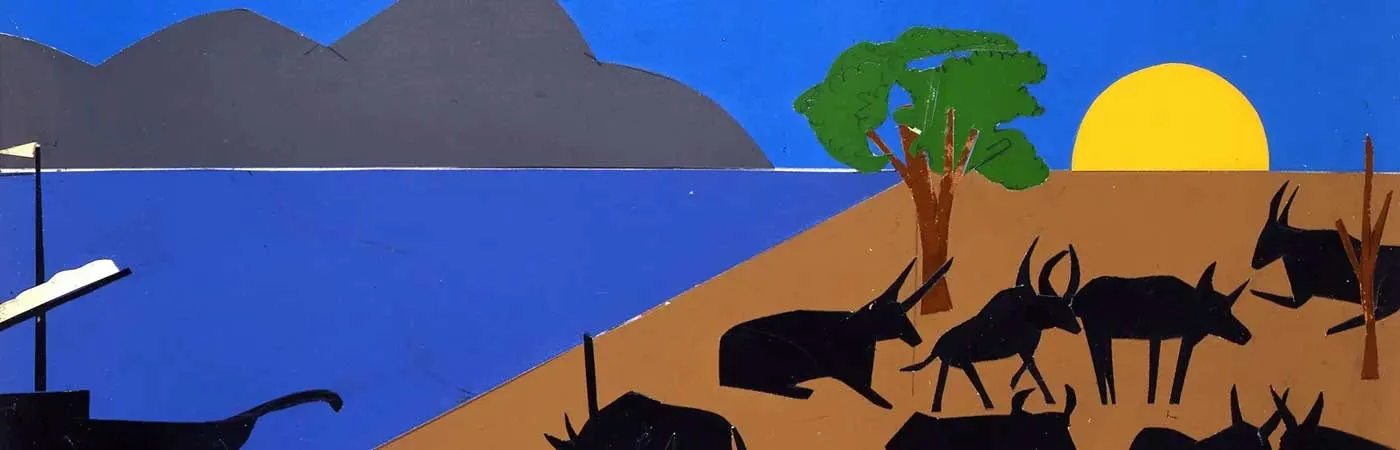
This website is a historical revelation, a resource for researchers and art lovers, and part of the Core Curriculum for all undergraduate students at Columbia University. Here we explore the work of Romare Bearden (1911–1988), one of the most powerful and original artists of the 20th century. In 1977, he created a cycle of 20 collages and watercolors (miniature variations of his collages) based on Homer’s epic poem "The Odyssey."
Rich in symbolism and allegorical content, Bearden’s “Odysseus Series” created an artistic bridge between classical mythology and African-American culture. The works conveyed a sense of timelessness and the universality of the human condition, but their brilliance was displayed for only two months in New York City before being scattered to private collections and public art museums.
This digital collection may be the only one of its kind of the artist's seminal work.
History

Romare Bearden's A Black Odyssey
In 2007-08, New York’s DC Moore Gallery restaged the original showing of the artist’s collages but included his watercolors (miniature variations of his collages), examples of his mid-1940s drawings based on Homer’s other epic, The Iliad, and other relevant work. Its show greatly increased the resonance and power of the original 20 collages.
In 2012, the Smithsonian Institution launched the travelling exhibition "Romare Bearden: A Black Odyssey," in cooperation with the Romare Bearden Foundation and Estate and DC Moore Gallery, supported by a grant from the Stavros Niarchos Foundation.
It was curated by Columbia literature and jazz expert Robert O'Meally, the Zora Neale Hurston Professor of English and Comparative Literature and founder and former director of the Center for Jazz Studies at Columbia. O'Meally and the Center made this website possible.
The exhibit returned home to Harlem in 2014, when it was on view at Columbia’s Miriam and Ira D. Wallach Art Gallery.
O'Meally literally wrote the book on the exhibition, a fully illustrated companion book of the same name published by DC Moore Gallery in 2008.
In March, Rizzoli published O'Meally's "Romare Bearden's Paris Blues: Painting Jazz." The publisher describes the the book as the "first publication to focus on a rarely seen series of jazz-infused collages that explore the African American experience and the artist's lifelong relationship to jazz music, by one of the most important and influential visual artists of the twentieth century."
In 2015, versions of the exhibit toured Columbia's Global Centers in Paris and Istanbul. The exhibition was part of a yearlong series of programs, lectures, and performances inspired by Bearden’s interpretation of Homer’s classic, a staple of Columbia’s undergraduate Core Curriculum. Organized by the Smithsonian Institution Traveling Exhibition Service in cooperation with the Romare Bearden Foundation and Estate and the DC Moore Gallery, the show was conceived and curated by Robert O’Meally, Columbia’s Zora Neale Hurston Professor of English, and is sponsored by the Stavros Niarchos Foundation.
The artist
A prominent African American artist often described as the consummate jazz painter, Bearden was known for his innovative collages that explored themes of Black American culture, history, and personal experiences. The exhibit and this website reexamines Bearden's life and work in the context of jazz, tracing the musician's impact from the artists' earliest oil paintings to his iconic collages.
Born in Charlotte, N.C., Bearden moved with his family to Harlem as a young child, part of the migration of African Americans from the South to greater opportunity in the North. Throughout his career, Bearden created images of the lives of travelers on their way to and from home, a theme no more powerfully explored than in his “Odysseus Series.”
Throughout his career, Bearden created images of the lives of travelers on their way to and from home, a theme no more powerfully explored than in A Black Odyssey. These works underscore the fact that this tale of the dislocated but heroic traveler’s search for a way home is Bearden’s own most pervasive and important artistic theme. The addition of a collage from Bearden’s 1968 series, Cotton Field, invites the viewer to consider the artist’s Homeric collages not as rarified explorations of Western antiquity but as evocations of familiar seekers of a welcoming place to stay.
Bearden had examined classical themes before, but the “Odysseus Series” expanded his exploration of literary narratives and artistic genres by presenting his own personal reinterpretation of the subject.
“In creating a black Odyssey series, Bearden not only staked a claim to the tales of ancient Greece as having modern relevance, he also made the claim of global cultural collage — that as humans, we are all collages of our unique experiences,” said O’Meally. “Indeed, Bearden does not merely illustrate Homer — he is Homer’s true collaborator, and he invites us as viewers to inherit Homer’s tale and interpret it as our own.”
A version of the project was presented in the University’s Global Center in Paris and in Istanbul and South Africa. The exhibition was part of a yearlong series of programs, lectures, and performances inspired by Bearden’s interpretation of Homer’s classic, a staple of Columbia’s undergraduate Core Curriculum. Organized by the Smithsonian Institution Traveling Exhibition Service in cooperation with the Romare Bearden Foundation and Estate and the DC Moore Gallery, the show was conceived and curated by Robert O’Meally, Columbia’s Zora Neale Hurston Professor of English, and is sponsored by the Stavros Niarchos Foundation.
Bearden was long a Harlem fixture, working for several years in a studio above the famed Apollo Theater, just a few blocks northeast of campus. “Bearden not only staked a claim to the tales of ancient Greece as having modern relevance," O'Meally said, "he also made the claim of global cultural collage—that as humans, we are all collages of our unique experiences."