"Bearden does not merely illustrate Homer, he is Homer’s true collaborator, and he invites us as viewers to inherit Homer’s tale and interpret it as our own."
Nearly half a century after African American artist Romare Bearden created an iconic series of works based on Homer’s "The Odyssey," his collages have taken on a new relevancy with a popular movie version of the classic in theaters and a revision of a controversial translation on the horizon.

The 2026 movie version of The Odyssey has created plenty of Oscar buzz as well as concerns by some about casting decisions – including the casting of a Black actor as Helen of Troy – and what the movie left out.
Book sales for Homer's classic surged around the world, especially for the most recent translation from 2017 by Emily Wilson. Her translation was generally well-reviewed when it was released and praised for its more modern language and less male-centric tone. More recent critics have deemed the translation "woke," but such observations have been dismissed by many as part of the broader culture wars raging online.
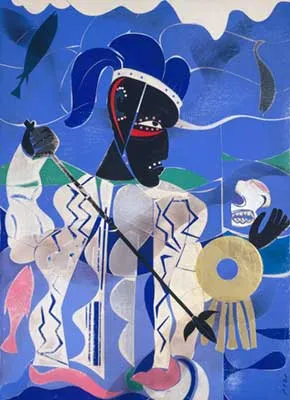
First created in 1977, Romare Bearden's Black Odyssey is a series of 20 collages based on episodes from Homer's epic tale "The Odyssey."
New York's DC Moore Gallery restaged the original showing of the collages but included his water colors, miniature variations of his collages that were examples of his mid-1940s drawings based on Homer's other epic, "The Iliad," and other works.
In 2012, the Smithsonian Institution exhibition expanded upon the DC Moore exhibit with "Romare Bearden: A Black Odyssey" and was curated by Columbia literature professor and jazz expert Robert O'Meally, author many books on literature, jazz and art, including the exhibit's companion book (2008 DC Moore Gallery), as well as "Romare Bearden: Paris Blues: Painting Jazz," published in March by Rizzoli Electa, and The Romare Bearden Reader (2019 Duke University Press).
Over a three-year period the exhibit traveled to major art venues in the United States, as well as at Columbia Global Centers in Paris and Istanbul. Its final stop in 2014-2015 was at the Wallach Art Gallery at Columbia University, where every undergraduate is required to read both The Iliad and The Odyssey as part of Columbia's Core Curriculum. Bearden’s paintings based on Homer — and the exhibition’s complementary conferences and concerts — had deep resonances on campus.
O'Meally wrote in the exhibition catalog's introduction why he thought Bearden chose a retelling of the Odyssey with black characters:
"Why, by the way, did Bearden choose to make all the characters in his many-layered re-telling of The Odyssey black? Surely he was being candid when he said he wanted black viewers to see themselves in the universal tale. Doubtless he also had his non-black viewers in mind, and the challenge for them to see themselves in black characters: black lovers, gods and villains, drop-dead goddesses (literally speaking) and beautiful saviors, underworld ghosts, and families in the nest protected by a guardian mom and a righteously angry daddy in the shape of a deep-sea god.
"Maybe above all Bearden’s point here is that we are all one global family, saints and sinners, all a collage of a human race living in a shape-shifting world. That we could only realize this global kinship and the mighty sense of responsibility it brings: this seems to be the overriding message of these bright blue pieced-together pictures."
Read more about the history of the exhibit and Romare Bearden.
Videos

July 16, 2018
In rare archival footage, Romare Bearden sheds light on his concepts and process, and how certain motifs in his art illuminate the African American experience.
March 12, 2015
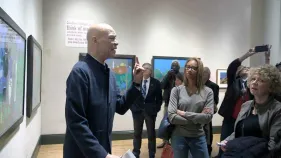
A Wallach Art Gallery visit with Robert O'Meally and Diedra Harris-Kelley, co-director of the Romare Bearden Foundation (and his niece), and an artist as activist and visionary.
Feb. 10, 2015
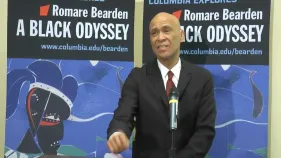
During the opening reception of the exhibition, Professor Robert O’Meally talks of how Romare Bearden "staked a claim to the tales of ancient Greece as having modern relevance."
News
“Romare Bearden: A Black Odyssey” Exhibition (Columbia News)
African American artist Romare Bearden’s iconic series of works based on Homer’s "The Odyssey" was featured at Columbia's Wallach Art Gallery.
"Romare Bearden: A Black Odyssey" Exhibition Opening Remarks (Columbia News)
Deborah Cullen gives a welcoming speech at the opening of Romare Bearden: A Black Odyssey at Miriam and Ira D. Wallach Art Gallery.
A Man of Twists and Turns (Columbia Magazine)
One Greek poet. One African-American artist. One intrepid professor. How Robert O’Meally brought Romare Bearden back to Harlem.
Related News
The Piece of Art That Inspired One of Theater’s Greatest Works (The New York Times)
An August Wilson classic wouldn’t exist without a Romare Bearden masterpiece. Here’s how the two are intertwined.
Supporters
*Romare Bearden: A Black Odyssey is organized by the Smithsonian Institution Traveling Exhibition Service in cooperation with the Romare Bearden Foundation and Estate and DC Moore Gallery. The exhibition and its related educational resources are supported by a grant from the Stavros Niarchos Foundation.
